Protect and grow your retirement savings with an IRA CD
Available to open online
Protect and grow your retirement savings with an IRA CD
Available to open online
Loading...
Online IRA CDs
APY
FINANCIAL INSTITUTIONS
APY*
APY
TERM
Term
MIN. DEPOSIT
minBalance
No Result
No Result Found
What is an IRA CD
An IRA CD is an interest-earning individual retirement account with funds invested in CDs instead of other assets like stocks or mutual funds. IRA CDs combine the safety and predictability of a CD with the tax advantages of an IRA.
IRA CDs can be a good strategy if you’re nearing retirement or already retired, or at any age if you’re looking to protect a portion of your retirement savings and receive a guaranteed rate of return. IRA CDs can provide federally insured safety, a predictable yield and tax-free growth.
Why choose an IRA CD
true-Box-ImgEasy eligibility
true-Box-ImgTax advantaged
true-Box-ImgCompetitive interest rates
true-Box-ImgReliable returns
true-Box-ImgNo setup or annual fees

How to open your IRA CD online

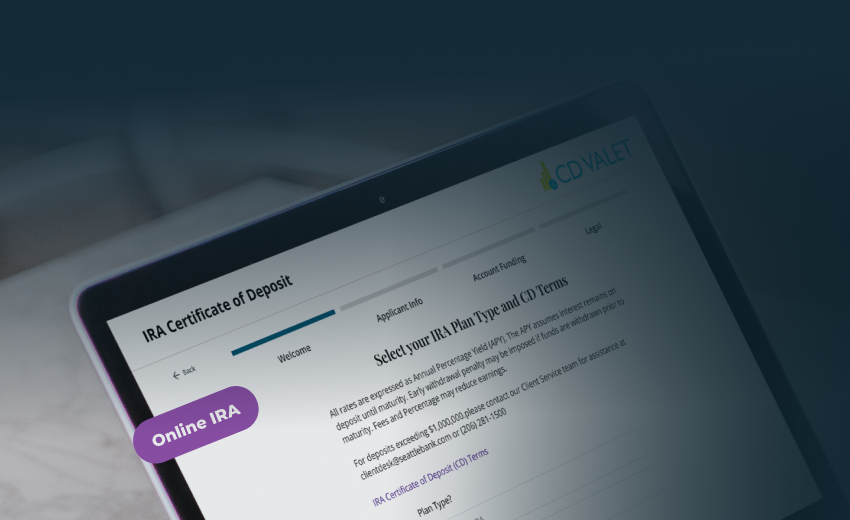
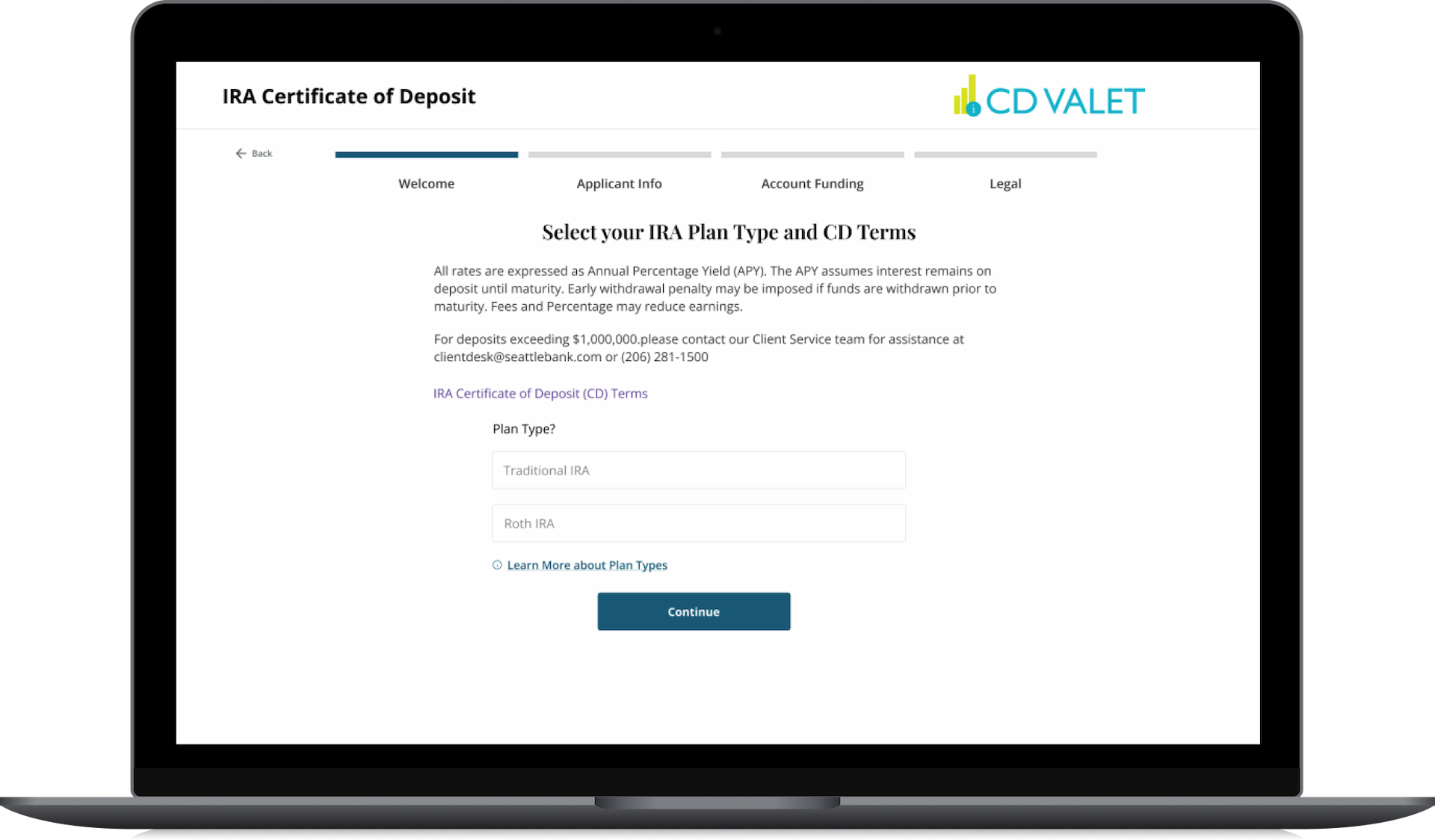
Found a great IRA CD rate with a financial institution on CD Valet? Click “Open Now” to begin the online account opening process, which will lead you through selecting your plan and contribution types, adding beneficiaries, signing plan and CD documents.
Please have the following ready for your application:
1
Access to a camera via computer or mobile device
2
Photo ID
3
Personal information such as name, address, email, phone
4
Identifying information such as your social security number
5
Your beneficiary’s name, address, and birthdate
6
Custodian’s information if funding via a Trustee Transfer from an existing IRA
7
Employer Sponsored Plan information if funding via a Direct Rollover from a company 401(k), 403(b) or governmental 457(b)

How to open your IRA CD online

Found a great IRA CD rate with a financial institution on CD Valet? Click “Open Now” to begin the online account opening process, which will lead you through selecting your plan and contribution types, adding beneficiaries, signing plan and CD documents.
Please have the following ready for your application:
1
Access to a camera via computer or mobile device
2
Photo ID
3
Personal information such as name, address, email, phone
4
Identifying information such as your social security number
5
Your beneficiary’s name, address, and birthdate
6
Custodian’s information if funding via a Trustee Transfer from an existing IRA
7
Employer Sponsored Plan information if funding via a Direct Rollover from a company 401(k), 403(b) or governmental 457(b)

  • Retirement Savings

    One of the top goals for most people is saving for retirement. With their tax advantages1 and easy eligibility, IRAs can be a powerful tool in saving for retirement. IRA funds compound and grow faster as the interest earned is not taxed each year.

  • Easy Eligibility

    Anyone with earned income can open a Traditional IRA, and possibly a non-working spouse if a joint tax return is filed. There are income and tax filing eligibility requirements to open a Roth IRA.

  • Easy to Open

    Most banks and brokerage firms offer IRAs along with several investment choices.

  • Tax Deferred or Tax-Free Earnings

    Interest earned on a Traditional IRA is not taxed until you withdraw it. For most people, withdrawals start after retirement when they're typically in a lower tax bracket. Interest earned on a Roth IRA is tax-free if the accountholder made their first Roth contribution at least five years prior to the withdrawal and is 59-½ years of age. Consult with a tax advisor for specific information.

  • Tax Break1

    Traditional IRA contributions may be tax deductible dependent on your participation in an employer sponsored retirement plan and your MAGI.

  • Investment Options

    You control how your IRA is invested. You can choose a low risk, high yielding FDIC bank certificate of deposit, or invest in stocks, bonds or mutual funds via a brokerage firm. You can move your IRA funds from one investment vehicle to another, or from one IRA Custodian to another via an IRA Trustee Transfer.

  • No or Low Fees

    Many IRAs don’t charge set up, monthly or annual fees, and if they do, the fee is typically much lower than a 401(k)-advisor fee.

  • Low Minimum Opening Balance Requirements

    Many IRAs have low opening balance requirements. Some as low as $100 to $1,000 depending on the investment vehicle.

  • Early Withdrawal Tax Penalty Exceptions

    There are exceptions that allow you to make a withdrawal from your IRA plan prior to age 59-1/2 without incurring an early withdrawal tax penalty. One of the exceptions is for qualified first-time home buyers who are allowed to withdraw up to $10,000 penalty-free. Please see the IRS site for additional exceptions to tax on early distributions. If you have your IRA funds in a CD, the early withdrawal penalty for removing funds during the CD term may still apply.

  • Traditional

    Anyone who has earned income is eligible to contribute to a Traditional IRA. However, the deductibility of the IRA is dependent on the accountholder’s participation in a qualified company retirement plan, their tax filing status1, and their Modified Adjusted Gross Income (MAGI). There are no age or income limits; as long as you have earned income, you can keep contributing to a Traditional IRA. A spouse with no income may be able to open and contribute to an IRA as long as one spouse has earned income, the married couple file a joint tax return, and the combined contributions of both spouses don’t exceed the taxable compensation reported on the joint tax return.

  • Roth

    There are two factors that determine whether you are eligible to contribute to a Roth IRA: your Modified Adjusted Gross Income (MAGI) and your tax filing status. If these totals are exceeded, you are not eligible to contribute to a Roth. There are no age limits; as long as you have earned income, you can keep contributing to a Roth IRA. A spouse with no income may be able to open and contribute to an IRA as long as one spouse has earned income, the married couple file a joint tax return, and the combined contributions of both spouses don't exceed the taxable compensation reported on the joint tax return.

    Roth MAGI Limits for 2024 :

    • Single tax filer: $ 161,000
    • Married, Joint Filing: $ 240,000
  • SEP

    Any size business, including self-employed individuals, can establish a SEP IRA easily by adopting FORM 5305-SEP, a SEP prototype, or an individually designed plan document. SEP IRAs are funded by employer contributions for the business owner and eligible employees. The employer must contribute equally for all eligible employees.

Contribution Types
  • Regular Annual Contributions

    Contribution limits apply. Please see the IRS site for current year contribution limits.

  • Rollover

    Funds from existing IRA accounts, or an employer-sponsored plan such as a 401(k), 403(b) or 457(b) plan where the funds have been paid to you, the IRA customer, and you currently have possession of those funds.

  • Direct Rollover

    Funds from an employer-sponsored plan such as a 401(k), 403(b) or 457(b) plan where the funds are held by the Plan Administrator and/or you, the IRA customer, received a check that is payable to the new IRA Custodian for the Benefit of (FBO) you, the IRA customer.

  • Custodian/Trustee Transfer

    Direct movement of IRA assets by the IRA Custodians. You, the IRA customer, do NOT have possession of the IRA funds. The funds transfer is done between IRA Custodians/Trustees. Or you received a check that is payable to the new IRA Custodian for the Benefit of (FBO) you, the IRA customer.

Contribution Limits
  • Traditional and Roth :

    For 2024, the total contributions you make to all of yourTraditional IRAsandRoth IRAscan't be more than:

    • $7,000 ($8,000 if you're age 50 or older - catch-up contribution), or
    • If less, your taxable compensation for the year

    The IRA contribution limit does not apply to:

  • SEP :

  • Contributions an employer can make to an employee's SEP-IRA cannot exceed the lesser of:

    • 25% of the employee's compensation
    • $69,000 for 2024

    Note:

    Elective salary deferrals and catch-up contributions are not permitted in SEP plans. Please see the SEP IRS site for more information.

Contribution Deadlines
  • Traditional

    You can make contributions for the prior year up to the tax filing date (excluding extensions), typically, April 15th.

  • Roth

    You can make contributions for the prior year up to the tax filing date (excluding extensions), typically, April 15th.

  • SEP

    You can set up an SEP plan and contribute for a year as late as the due date (including extensions) of your business income tax return for the year you want to establish the plan.

IRA to IRA
TypeSource of AssetsFunds Paid to IRA OwnerContribution Deposited IntoContribution Reported As
Trustee TransferTraditional IRANoTraditional IRANot Reported
Roth IRANoRoth IRANot Reported
IRA RolloverTraditional IRAYesTraditional IRARollover
Roth IRAYesRoth IRARollover
Employer-Sponsored Retirement Plan (ESP) to IRA
TypeSource of AssetsFunds Paid to IRA OwnerContribution Deposited IntoContribution Reported As
Direct RolloverEmployer-Sponsored Plan (ESP)NoTraditional IRARollover
Designated Roth Account in an ESPNoRoth IRARollover
Indirect RolloverEmployer-Sponsored Plan (ESP)YesTraditional IRARollover
Roth IRAYesRoth IRARollover

  • Traditional

    IRS penalty incurred for withdrawals prior to age 59-1/2.Required Minimum Distributions (RMD), the minimum amount of money that must be withdrawn annually per the IRS, start at age 73. Distributions are taxed when withdrawn (if the contribution was not deductible, only the interest earned is taxed when withdrawn). CD early withdrawal penalty also applies if funds are withdrawn prior to the CD maturity date. No CD penalty charged for RMDs.

  • Roth

    IRS penalty incurred for withdrawals of earnings prior to age 59-1/2.No required minimum distributions. Interest earnings will be distributed tax free if the accountholder made their first Roth contribution at least five years prior to the withdrawal and is at least 59-1/2 years of age. CD early withdrawal penalty also applies if funds are withdrawn prior to the CD maturity date.

  • SEP

    IRS penalty incurred for withdrawals prior to age 59-1/2.Required Minimum Distributions (RMD), the minimum amount of money that must be withdrawn annually per the IRS, start at age 73. Distributions are taxed when withdrawn. CD early withdrawal penalty also applies if funds are withdrawn prior to the CD maturity date. No CD penalty charged for RMDs.

  • A beneficiary can be a U.S. person, charity or non-profit organization, a trust, or your estate. The individual can be a minor under 18 years old.

  • An IRA accountholder can name both Primary and Contingent beneficiaries. If the IRA accountholder is deceased, funds will be paid to the primary beneficiaries. If the primary beneficiaries precede the IRA accountholder in death, the funds will be paid to the contingent beneficiaries. If more than one primary beneficiary or one contingent beneficiary is designated and no percentages are indicated, the beneficiaries will be deemed to own equal share percentages of the IRA.

  • If you are married and reside in a community property state, you must designate your spouse as your sole primary beneficiary. If you choose to designate a primary beneficiary other than or in addition to your spouse, your spouse must sign a waiver consent.

Annual Percentage Yields (APY) are from the latest rate surveys which are typically completed every business day. Rates are based on public data for comparable CD products. Additional restrictions and requirements may apply. The APY assumes interest remains on deposit until maturity. Early withdrawal penalty may be imposed if funds are withdrawn prior to maturity. Fees and penalties may reduce earnings. IRA CD: Withdrawals before age 59 1/2 may be subject to a 10% federal tax and possible state tax, in addition to an early withdrawal penalty. IRA contribution limits apply. Restrictions may apply.
1Consult a tax advisor
* Annual Percentage Yield (APY) for certificates of deposits are from the latest rate surveys which are updated as often as daily. Rates are based on publicly available data for CD products. Additional restrictions and requirements may apply. The APY assumes interest remains on deposit until maturity. Early withdrawal penalty may be imposed if funds are withdrawn prior to maturity. Fees and penalties may reduce earnings. The APY for variable CD Rates may change after the account is opened.

** Annual Percentage Yield (APY) for High Yield Savings Accounts (HYSA) are effective as of the date shown above. HYSA are variable rate accounts. Rates may change after the account is opened. Fees may reduce earnings. Additional restrictions and requirements may apply. Please review the account deposit agreement and fee schedule for the financial institution for further information regarding fees, terms, and conditions.

Tiered rates may be included in the account listings. Please refer to the financial institution's website for the full listing of any tiered rates. Visitors should independently verify all terms, conditions, and limitations including, but not limited to deposit insurance coverage, credit union eligibility and membership requirements. CD Valet is not a federally insured deposit institution; deposit insurance is offered through the bank or credit union. CD Valet is compensated by a limited number of financial institutions that have either contracted marketing services with CD Valet or have an Open Now or affiliate link on CD Valet. Visit our Privacy and Disclosure Center to read related disclosures and policies of CD Valet and its partners.


  • Shop, compare and open CDs with the most competitive rates in your local market.

scrollLogo
Loading...